m-session notes
News, updates, and things we’ve learned while building m-session.

A Journey in Three
There’s a gap in MDMA-assisted therapy that isn’t talked about. The drug moves through distinct pharmacological phases over six to eight hours, but the therapeutic approach treats the session as a single uniform event. Clinical protocols like MAPS describe one non-directive posture held from start to finish: follow the patient’s lead, don’t direct. Experienced therapists no doubt adapt as the chemistry shifts before them, but that adaptation hasn’t been formally documented. There’s no framework for connecting the pharmacological arc to corresponding shifts in technique.
With m-session we’ve developed a three-phase framework, each matched to a different neurochemical window and a different kind of therapeutic work: come-up, peak, and synthesis.
Come-up (0 to ~90 minutes)
Your body is doing a lot here. Heart rate rising, blood pressure climbing, the sympathetic nervous system spinning up as MDMA floods serotonin, norepinephrine, and dopamine into the synaptic space. Oxytocin is beginning to climb. Many people feel a wave of anxiety during this window, a physical sense that something significant has started but hasn’t fully declared itself yet.
This is not the time for deep emotional excavation. The system is ramping up and the most useful thing you can do is stay grounded inside it. Body scans, breath awareness, light music, feeling where your back makes contact with whatever you’re lying on. You’re building a baseline of somatic attention that will carry the rest of the session, learning to listen to the body and tune into the parasympathetic nervous system before the volume gets turned up.
Peak (~90 minutes to 3.5 hours)
If you’re reading this you probably know what a peak is. Serotonin release at its highest, oxytocin and vasopressin elevated, increasing openness and trust, and dampening the brain’s threat response. Amygdala activity is suppressed, which means the fear that normally intercepts painful material before you can look at it directly has, for a few hours, stepped aside.
Analytical thinking is present during the peak but not dominant. What’s dominant is emotional depth, somatic vividness, and an unusual willingness to approach things the mind normally deflects. This is where therapeutic frameworks focused on exposure to difficult material do best (Gendlin Focusing, Coherence Theory therapy), since the simple practice of staying with something difficult without pulling away becomes possible in ways it rarely is in ordinary consciousness. Somatic work with the body and sensation seems to show good results, as does a heart opening practice like Metta loving-kindness or gratitude practices. Peak pharmacology is holding the door open for real breakthrough work.
Synthesis (~3.5 to 6+ hours)
This window is often called “coming down,” which frames it as diminishment, but what’s actually happening is more interesting. The peak has subsided and serotonin is tapering, but emotional openness doesn’t vanish when intensity drops. It lingers, sometimes for hours. What’s changing is that reflective capacity is coming back online. The ability to draw connections, see patterns, assign meaning to what was previously raw and overwhelming feeling. You have simultaneous access to the emotional depth of the peak and the cognitive clarity to actually understand it. A useful combination that is rare in ordinary consciousness. Hegelian dialectic abounds.
Synthesis is the resolution, where what broke open during the peak meets the returning ability to make sense of it. This is where journaling lands hardest, where values mapping reveals patterns that were invisible an hour earlier, where a letter to someone writes itself with a clarity that won’t be available tomorrow. The synthesis phase can also lay the groundwork for richer integration work in the days and weeks that follow. The experiences of MDMA—the life framing that might have been realized or the insight about self that may have been gained, the deep feeling of it all—these valuable moments of experience often fade from memory without a linguistic handle. Synthesis work can be the handle that makes accessing and integrating these fleeting insights possible.
A Journey in Three
This is the core idea behind m-session. The pharmacological arc isn’t just background chemistry. It’s a map, and different points on that map call for different kinds of work. Grounding and somatic attention while the body is activating. Deep emotional work while the defenses are down. Reflection and meaning-making while the mind is coming back online with the heart still open. None of this is radical, and it probably sounds obvious, but from our research and experience it just hasn’t been formalized before. We think it’s worth investigating deeper, and we’re curious what others find when they work with it.
Two new meditations: Metta Heart and The House of Jung
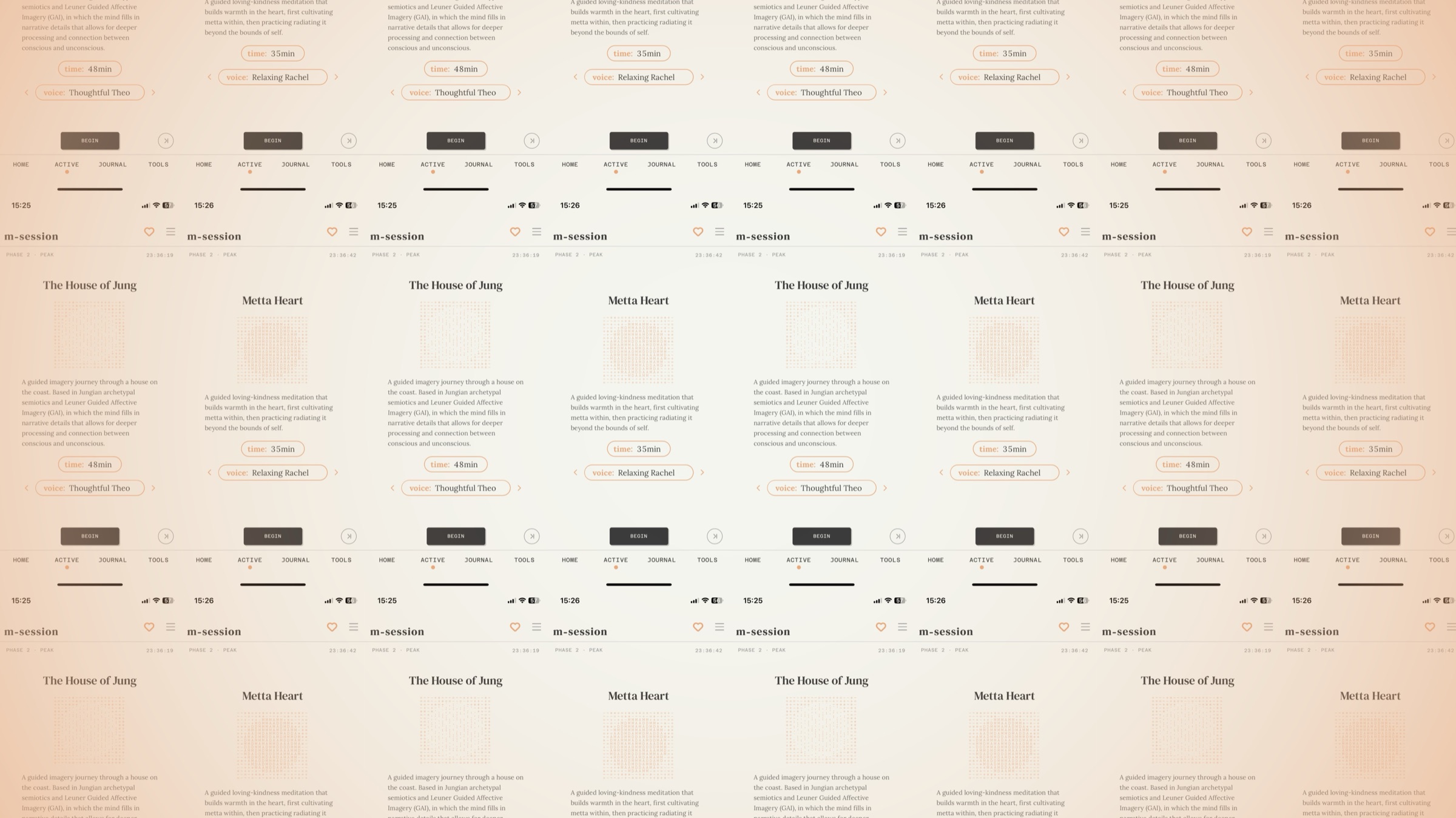
We recently added two long-form guided meditations to the m-session library. Both are around 30 minutes, audio-guided with two voice options, and designed for the peak phase of a session. They represent two very different approaches to inner work, and they’re both among the deepest activities in the app.
Metta Heart
Metta, often translated as loving-kindness, is one of the oldest meditation practices in Buddhist tradition. The classical Theravada approach, codified in Buddhaghosa’s Visuddhimagga in the 5th century, progresses through categories of people: first yourself, then a benefactor, a friend, a neutral person, a difficult person, and finally all beings. You silently repeat phrases like “may you be happy, may you be free from suffering” at each stage, gradually expanding the circle of who you’re willing to wish well.
Metta Heart draws on this tradition but synthesizes it with two other streams. The first is somatic. Rather than treating metta as a purely mental intention, the meditation anchors it in the body. You guide the breath into the heart center, feel for whatever warmth or sensation is there, and let it radiate physically through the chest, the limbs, the skin. Under MDMA, where the body is already unusually vivid and available, this somatic dimension makes the practice tangible in a way that purely phrase-based metta sometimes isn’t. The second stream is contemplative and non-dual. After the traditional progression from self to another to all beings, the meditation moves into territory that most loving-kindness practices don’t enter: dissolving the boundary between sender and receiver. The one who is offering love and the love itself become harder to distinguish. This is where the meditation gets genuinely deep, and where MDMA’s capacity to thin the sense of a separate self meets contemplative ground that normally takes years of practice to reach.
The phrases we use are “May I be well. May I feel deep love. May I be filled with light.” That last one may seem a bit unusual or nonsensical (what does it actually mean to be filled with light?), but this wording is drawing on ideas of Rob Burbea and other Jhana practitioners who use imagery to make it easier for somatic sensations to arise — the feeling of Piti in the body. The meditation makes clear that these are seeds, not scripture, and if different words carry more meaning, you’re encouraged to use those.
The House of Jung
Carl Jung believed the unconscious communicates through images, not arguments. His concept of archetypes — recurring symbolic patterns that appear across cultures and throughout human history — was rooted in the observation that the psyche organizes itself around certain fundamental structures: the shadow (what we’ve disowned), the anima or animus (the contrasexual dimension of the self), the wise figure, the descent and return. Jung’s method of active imagination invited people to engage these images directly, to enter a kind of waking dream and let the unconscious populate it with whatever needed to be seen.
Hanscarl Leuner, a German psychiatrist working at the University of Göttingen in the 1950s, took this idea further. He developed a clinical method he called Psycholytic Therapy, combining guided mental imagery with low-dose hallucinogens to help patients access preconscious material that talk therapy alone couldn’t reach. He founded the European Medical Society for Psycholytic Therapy in 1961 and published extensively on the patterns he observed: that when you give the unconscious a narrative scaffold and reduce the mind’s usual defenses, the material that emerges is remarkably consistent and therapeutically meaningful. After hallucinogens were prohibited across Europe, Leuner adapted his approach into what he called Guided Affective Imagery, a non-pharmacological method that preserved the same principles. You provide the architecture of a scene, and the patient’s unconscious fills in every significant detail.
The House of Jung is built directly on this lineage. It’s a complete guided imagery journey: arrival at a house on the coast at dusk, exploration of its rooms, the discovery of a childhood bedroom, a hidden door, a spiral descent into the depths beneath the house, an encounter with a shadowy figure, an offering, and a return through a renewed greenhouse to dawn over the ocean. The meditation doesn’t tell you what the house looks like, what the figure is, or what you feel. It provides the scaffolding and trusts the unconscious to do what it does. Under MDMA, where the fear response that normally censors unconscious material is softened, this projective capacity is heightened. People see things they wouldn’t ordinarily let themselves see, and they can stay with what they find rather than flinching away. The descent-and-return structure maps to what Jung called individuation: meeting the parts of yourself that have been kept underground, offering them something, and carrying what you’ve found back into the light.
Both meditations are available now in the module library. If you try either of them during a session, we’d genuinely like to hear what the experience was like.
Why meditation and MDMA mix
When I tell people I’m building a guided meditation app for MDMA sessions, I can usually see the confusion before they say anything. The assumption is that someone on MDMA would be too high to follow a meditation. That they’d be hallucinating, or too scattered, or too far gone to do anything structured.
It’s a reasonable assumption if you think of MDMA as a classical psychedelic. But most would actually put MDMA into a category of its own. Some refer to it as an empathogen, a portmanteau meaning “to generate empathy,” and others as an entactogen, derived from the Latin entacto meaning to touch something inside or interior to the self. It doesn’t dissolve your sense of self or warp your perception of reality. Most people who take it at a therapeutic dose report the opposite: that their thinking becomes clearer, not cloudier. That they can see themselves and their lives with a kind of honest, undefended lucidity that is normally very hard to access.
The research backs this up. A 2024 cross-over study in the American Journal of Psychiatry compared MDMA directly against LSD and found that cognitive and perceptual lucidity remain fully intact under MDMA. A meta-analysis the same year confirmed the pattern: psychedelics impair attention and executive function during use, while MDMA leaves both unaffected. The capacities that meditation depends on — sustained attention, the ability to follow instructions, honest self-observation — are not only preserved under MDMA but often feel enhanced.
That combination of clarity and emotional openness is what makes the pairing so effective. The body becomes more available. Tension you didn’t know you were carrying becomes obvious. The felt sense — a concept from Gendlin’s Focusing that many people struggle to locate sober — often becomes immediately accessible. At the same time, the defensive filter that usually intercepts difficult material before you can really look at it quiets down. The MAPS treatment manual describes this as an “internal awareness that even painful feelings that arise are an important part of the therapeutic process.” Meditation provides the container for that awareness. It gives the openness a direction rather than letting it dissipate as a pleasant but formless feeling.
There’s also a specific overlap between loving-kindness meditation and MDMA’s empathogenic effects, with recent papers in the Journal of Psychedelic Studies (2025) and Pharmacological Reports (2023) both pointing to shared mechanisms around empathy and self-compassion. The warmth that metta practitioners spend years learning to cultivate often arrives within minutes under MDMA. The meditation gives that warmth somewhere to go and builds that “muscle” to make it more easily accessible.
This convergence is central to how m-session is built. The guided meditations in the app are designed for a state where the body and mind are unusually receptive, and they form the backbone of the session experience. The research on this synergy is still early, but the foundation is strong and the lived experience of people who have combined the two consistently points in the same direction.
My own experience is that MDMA allows me to really slow down and experience moment by moment what is most important to me, whether that’s feeling love, feeling something in my body, or going deeper into my mind. I wouldn’t describe it as being high. More as being more in touch. Meditation is the practice that helps me stay there.
—dasloops